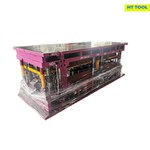
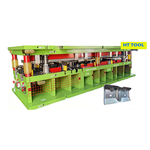
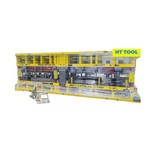
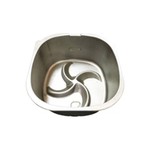
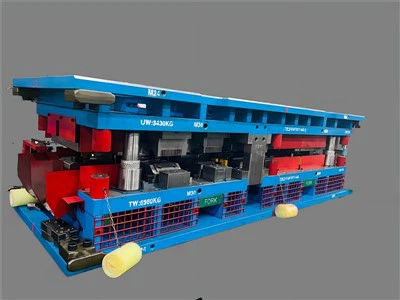
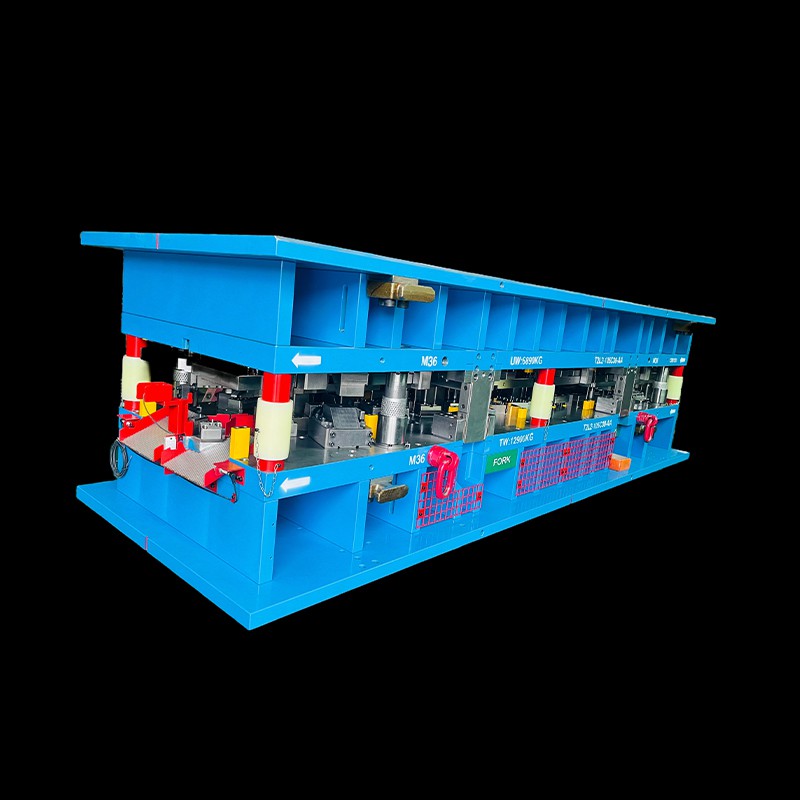
Q: What is automotive transfer die ?
A: An automotive metal transfer die is a type of tooling device used in automotive manufacturing lines. They are usually specially designed dies that are used to hold and transfer automotive parts to ensure their proper position and orientation during the manufacturing process. These tools can include jigs, fixture plates, fixture jaws, etc. that are used to hold and position automotive parts so that they can be accurately transferred to the next workstation or work area on the production line. Automotive transfer die play an important role in automotive manufacturing, helping to automate and efficiently run production lines.
Q: when to use Automotive Transfer Die Stamping?
A:
- Large Parts that require transfer among several presses for completion
- Frames and Structural Components
- Shells
- Tube applications
Q: What are the features of the automotive transfer die?
A: (1) It is used in multi-station press;
(2) Each station is a complete engineering mold to complete a specific process. Each engineering mold (submold) has a certain connection, each work step submold can be adjusted independently, and the adjustment is generally not limited by the front and rear sub dies;
(3) Transferring method: robotic transferring.
Q: What is the difference between progressive die and automotive transfer die?
A: Distinct from progressive dies, transfer dies involve the process of stamping a material, transferring it to another station for further stamping, and repeating this sequence through a mechanical transfer process. This method enables the execution of intricate operations and enhances production efficiency. Automotive transfer dies accommodate larger die sizes. The automotive sector, in particular, stands to gain significant advantages from transfer dies. Precision dies enable the creation of highly accurate representations of complex designs. Unconventional projects no longer face constraints typical of other manufacturing methods, including progressive dies. When confronted with a design necessitating a custom solution unsuitable for mass production using conventional techniques, transfer dies offer the most viable long-term and cost-effective solution.
Q: Why choose HT TOOL as your automotive transfer die partner?
A: Because the process of automotive transfer die stamping involves multiple steps, it doesn't imply that it lacks the capability for high volume production. Its performance remains consistently reliable and swift, offering not just superior quality but also efficiency. For those seeking high-volume and precise production, having top-notch manufacturing equipment and proficient staff adept in software utilization is imperative. A proficient provider should be capable of delivering prototypes, conceptual models, and full-scale production. If your requirements entail the use of large dies, it's advisable to explore companies like HT TOOL.
Q: Why choose HT TOOL as your automotive transfer die partner?
A: Because the process of automotive transfer die stamping involves multiple steps, it doesn't imply that it lacks the capability for high volume production. Its performance remains consistently reliable and swift, offering not just superior quality but also efficiency. For those seeking high-volume and precise production, having top-notch manufacturing equipment and proficient staff adept in software utilization is imperative. A proficient provider should be capable of delivering prototypes, conceptual models, and full-scale production. If your requirements entail the use of large dies, it's advisable to explore companies like HT TOOL.
Q: What is the role of automotive transfer dies in automotive manufacturing?
A: The role of automotive transfer die in automotive manufacturing is to accurately position and transfer automotive parts to ensure efficient, automated production line operations.
Q: How can automotive transfer die be designed to ensure flexibility between different models and part sizes?
A: Metal automotive transfer die are designed to ensure flexibility between different models and part sizes through adjustable clamping, positioning and drive mechanisms, as well as modular design and quick part changes.
Q: What factors need to be considered in the design and manufacture of automotive automotive transfer die?
A: 1.Part size and shape.
2.Safety: design the Metal automotive transfer dieto ensure the safety of the operator,
3.Material selection: choose the right material to ensure that the Metal automotive transfer diehas sufficient strength and wear resistance.
4. Degree of automation to improve productivity. 5. Cost control: consider cost factors in the design and manufacturing process, and strive to reduce the manufacturing cost and improve the return on investment.
Q: What is the impact of automotive transfer die on production efficiency and cost in the automotive industry?
A: 1. Improve production efficiency: automotive transfer die can realize fast positioning, precise transfer and efficient production of parts, reduce the downtime of the production line and improve production efficiency.
2. Reduce production costs: automotive transfer die can automate the production process, reduce human input, reduce human error in the production process, thus reducing production costs.
3. Improve product quality: automotive transfer die can ensure accurate positioning and delivery of parts, avoiding product defects caused by operational errors or human factors, thus improving product quality.
4. Accurate production scheduling: automotive transfer die can be integrated with the production line to achieve accurate production scheduling and parts delivery, reduce inventory backlog and overproduction, and improve the flexibility and responsiveness of production planning.
Q: What is the future development trend of transfer dies?
A: The future of automotive transfer die may be towards the direction of intelligent, flexible, energy efficient, data-driven, personalized customization and lightweight.
1. Intelligence and automation: with the development of Industry 4.0, conveyor molds may become more and more intelligent and automated, realizing smarter production scheduling and parts handling through the integration of sensors, machine learning and artificial intelligence technologies.
2. Flexible production: future conveyor molds may pay more attention to flexible production capacity, able to quickly adapt to changes in different product models and production demand, and improve the flexibility and adaptability of the production line.
3. Efficient energy consumption: the future conveyor mold may pay more attention to energy saving and environmental protection, using more energy-efficient transmission devices and manufacturing processes, reduce energy consumption and environmental pollution.
4.data-driven: conveyor dies may pay more attention to data analysis and production optimization, through real-time monitoring and analysis of production data, optimize the production process and scheduling solutions to improve production efficiency and quality.
Q: How does a Metal automotive transfer die ensure accurate positioning and transfer of parts during production?
A: Transfer dies ensure accurate positioning and transfer of parts during production through precisely designed clamping, positioning and guiding devices. Clamping devices are used to securely hold the part, positioning devices are used to ensure the position and orientation of the part, and guides guide the part along a predetermined path for transfer. These devices, in conjunction with the operation of the transfer system, allow the parts to be transferred in the prescribed steps and positions, thus ensuring accurate positioning and transfer of the parts during the production process.
Q: How does an automotive transfer die work?
A: The working principle of an automotive transfer die is to transfer parts from one workstation to another through a conveyor system to complete the processing and assembly of different processes. The conveyor system usually consists of a drive, conveyor chain or belt, clamping device, positioning device and guiding device. The drive provides the power, the conveyor chain or belt transfers the parts along a predetermined path, the clamping device holds and secures the parts, the positioning device ensures accurate positioning of the parts, and the guiding device guides the parts along the correct path for transfer. The working principle of the automotive Metal automotive transfer die is to realize the automatic transfer and processing of parts in the production line through the coordinated action of these devices.
Q: What are some application examples of automotive transfer die in automotive manufacturing?
A: 1. Body welding line:automotive transfer die are used to transfer body parts from one station to the next station for welding, assembly and other processes.
2. Automotive seat production line:automotive transfer die are used to transfer seat parts from one process to the next to complete the assembly and adjustment of the seat.
3. Engine assembly line: the transfer mold is used to transfer the engine parts from different processes to complete the assembly and adjustment of the engine.
4. Door assembly line: the transfer die are used to transfer the door parts from stamping, welding and other processes to the assembly process, to complete the assembly and installation of the door.
Q: What are the key points for the maintenance and upkeep of transfer dies?
A: 1. Regular cleaning: Clean the surface and interior of the transfer dies regularly to ensure that there is no accumulation of impurities, so as to avoid affecting the normal operation of the transmission system and the clamping device.
2. Lubricate and maintain: Regularly lubricate and maintain the transmission device and bearings and other components.
3. Check the clamping device: Check the clamping force and stability of the clamping device regularly.
4. Calibrate the positioning device: Calibrate the positioning device regularly to ensure that the parts can be accurately positioned to avoid production quality problems caused by inaccurate positioning.
5. Inspection of transmission system: Regularly inspect the chain, belt, transmission device and other components of the transmission system.
6. Preventive Maintenance: Regular preventive maintenance is carried out to check all parts of the transfer dies, and problems are found to be repaired in time, so as to avoid production interruptions and losses caused by failures.
7. Training of operators: Train operators, teach correct use and maintenance methods, improve operators' skills and awareness, and reduce damage caused by misuse.