


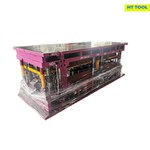
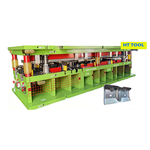
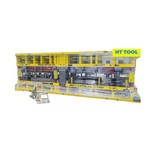
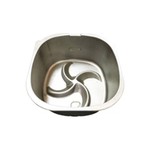
Home Appliance Die
Company Profile
HT TOOL is highly experienced with Progressive Tooling from medium to high complex parts up to 1300mm width. Our costumers can expect to achieve the maximum productivity/quality from our progressive tools.
Why Choose Us
Rich Experience
Continuously providing our customers with diverse and highest quality die making services and delivering first-class metal stamping dies and parts with precision, accuracy, speed and efficiency.
One-stop Solution
HT TOOL is committed to providing reliable one-stop solutions for the tool and die industry, and through our strengths to become the preferred supplier within the metal stamping die industry.
Professional Team
In tooling design department, we are able to provide a comprehensive service to our customers. Our project managers (x2) are in permanent contact with our customers during the project development process and during the mass production of the dies.
Customized services
Our assembly units offer maximum flexibility to meet our customers' needs, adding value to each part with customer satisfaction in mind.
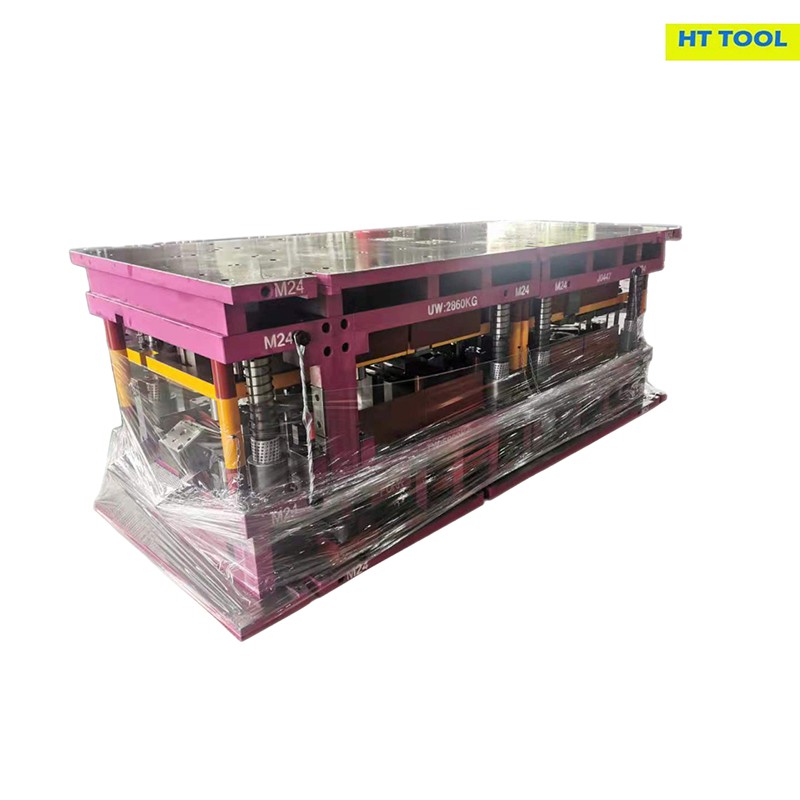



Home appliance die also referred to as "electrical appliance mould," pertains to the production of plastic components for household electric appliances. These moulds encompass both the interior plastic parts and the external housing or casing.In the precision injection molding manufacturing of major appliances, a high-precision home appliance plastic injection mould is indispensable. The home appliance industry necessitates tailor-made plastic injection moulds suitable for insert molding, overmolding, or thin-wall molded products.
The mold is created using a combination of materials, such as steel, aluminum, copper, and brass, to ensure durability and longevity.
Benefits of Home Appliance Die
Consistent Quality
Home appliance die ensures that the parts produced are of consistent quality. The mold is designed to produce parts that are identical in shape and size, ensuring that the final product is of high quality.
Design Flexibility
Home appliance die allows for design flexibility. The mold can be designed to produce parts of different shapes and sizes, ensuring that the final product is unique and of high quality.
Precision and accuracy
Home appliances often have intricate designs and precise specifications. Therefore, the molds used to produce their components must meet strict dimensional accuracy requirements to ensure proper fit and functionality.
Durability and longevity
Home appliances are expected to have a long lifespan, so the molds used to manufacture their components must be durable and capable of withstanding the high pressures and temperatures of the injection molding process over numerous production cycles.
Consistency and reliability
Home appliance manufacturers demand consistency and reliability in their production processes to maintain product quality and brand reputation. Injection molds must produce parts with minimal variation and defects to meet these requirements.
Type Of Home Appliance Die
Single Cavity Injection Mold
The single cavity injection mold is the simplest type of mold used in the production of home appliances. It is designed to produce a single part at a time, making it ideal for small-scale production. The mold is made up of a single cavity, which is used to create the desired shape of the part. The single cavity injection mold is cost-effective and easy to maintain, making it a popular choice in the manufacturing industry.
Multi-Cavity Injection Mold
The multi-cavity injection mold is designed to produce multiple parts at a time. It is ideal for large-scale production, as it can produce several parts simultaneously. The mold is made up of multiple cavities, each of which is used to create the desired shape of the part. The multi-cavity injection mold is more expensive than the single cavity injection mold, but it is more efficient in terms of production output.


Family Injection Mold
The family injection mold is designed to produce multiple parts that are related to each other. It is ideal for the production of home appliances that have several parts that are similar in shape and size. The mold is made up of multiple cavities, each of which is used to create a different part. The family injection mold is more complex than the single cavity injection mold and the multi-cavity injection mold, but it is more efficient in terms of production output.
Hot Runner Injection Mold
The hot runner mold is designed to produce parts that require a high level of precision. It is ideal for the production of home appliances that have complex shapes and designs. The mold is made up of a heating system that ensures the plastic material flows smoothly through the mold. The hot runner injection mold is more expensive than the other types of molds, but it is more precise in terms of production output.
Materials Used in Home Appliance Die
Steel
Steel is the most common material used in home appliance injection mold. It is durable, strong, and can withstand high temperatures. Steel molds are ideal for large-scale production, as they can produce several parts at a time.
Aluminum
Aluminum is a lightweight material that is ideal for small-scale production. It is easy to work with and can produce high-quality parts. Aluminum molds are cost-effective and can be used for producing small quantities of parts.
Copper
Copper is a durable material that is ideal for producing parts that require a high level of precision. It is expensive, but it can produce parts that are of high quality and precision.
Brass
Brass is a durable material that is ideal for producing parts that require a high level of precision. It is expensive, but it can produce parts that are of high quality and precision.
Design Points of home appliance die
The wall thickness of a plastic part is primarily influenced by its external dimensions and materials. However, in the design of plastic products, maintaining a uniform wall thickness is a fundamental principle. Deviations in wall thickness can lead to defects in the appearance of plastic parts, including shrinkage, depressions, deformations, and internal stress, ultimately resulting in cracks.
If the wall thickness is too thin, it can increase the resistance to the flow of molten plastic, impede material flow in the cavity, making it challenging to fill the material. This results in unfilled areas and compromised strength in the plastic parts.
The stress concentration at sharp corners in injection-molded cases can result in brittle failures. Eliminating sharp corners reduces stress concentration, reinforcing rib strength, and enhances the product's ability to withstand external impact.
Reinforcing ribs enhance the structural strength of plastic parts, reducing the likelihood of warping, plastic consumption, product weight, and production costs without increasing wall thickness. In rib design, strict control of rib position, height, and even distribution helps avoid cold shrinkage at the rib bottom. Maintaining consistency between rib distribution and melt filling direction aids in the injection mold's opening and closing. Adopting an arc transition for reinforcing ribs and rounding corners at the bottom of ribs improves melt fluidity and reduces stress concentration. Typically, reinforcing ribs are around 50% to 70% of the wall thickness, with the r angle at the bottom being approximately 1/8 of the wall thickness.
What Is The Manufacturing Process Of home appliance die
Design Phase
The process begins with the design phase, where engineers and designers at the Home Appliance Mould Factory collaborate with clients to create detailed blueprints and specifications for the mold. Advanced CAD/CAM software is utilized to develop precise 3D models, considering factors such as product dimensions, material requirements, and parting lines.
Material Selection
Once the design is finalized, the next step is selecting suitable materials for the mold. Factors such as durability, thermal conductivity, and cost-effectiveness are considered. Common materials include steel, aluminum, and various alloys, chosen based on the specific requirements of the home appliance.
Tooling Preparation
With the design and material specifications in place, the factory prepares the tooling necessary for mold production. This involves machining raw materials into the desired shapes and sizes using CNC milling machines, lathes, and other precision equipment.
Mold Construction
The actual construction of the mold begins, typically starting with the fabrication of the mold base and cavity inserts. Skilled technicians meticulously assemble the components, ensuring tight tolerances and proper alignment. Cooling channels are integrated into the mold to facilitate efficient heat dissipation during the molding process.
Surface Treatment
Surface treatment techniques such as polishing, grinding, and coating may be applied to enhance the mold's surface finish and durability. These processes help prevent corrosion, reduce friction, and improve the release of molded parts.
Testing and Validation
Once the mold construction is complete, it undergoes rigorous testing and validation procedures. Quality control technicians inspect the mold for any defects or imsuperbions, ensuring that it meets the specified dimensions and performance criteria. Test runs may be conducted to verify the mold's functionality and compatibility with the intended home appliance.
Production and Delivery
Upon successful validation, the Home Appliance Mould Factory initiates mass production of the molds. Advanced injection molding machines are used to inject molten plastic into the molds, forming the final product. The finished molds are then carefully packaged and delivered to the client, ready for use in the production of home appliances.
In terms of materials, the application of new plastic materials is an important innovation in the manufacture of appliance molds. New plastic materials with high strength, high temperature resistance and excellent flame retardant properties are widely used in the manufacture of home appliance molds to meet the higher requirements of modern home appliance products for performance and safety. These materials not only improve the durability of the products, but also make the mold manufacturing process more flexible, better adapted to different design and functional requirements.
Advanced manufacturing technologies are also widely used in the appliance mold industry. The introduction of technologies such as cnc machining, 3d printing, and mold runner optimization have made the mold manufacturing process more precise and efficient. Through these technological innovations, manufacturers are able to design and manufacture high-quality appliance molds more quickly, increase productivity and reduce costs.
The concept of environmental protection and sustainable development has also driven the innovation of appliance mold materials and technologies. The use of biodegradable materials not only helps to reduce environmental impact, but also meets the growing consumer interest in sustainable products. Some manufacturers are introducing recycled materials into mold manufacturing to reduce resource consumption and enhance the sustainability of the industry as a whole.
In the future, we can expect to see more innovations based on artificial intelligence and digital technology, making mold design and manufacturing smarter and more accurate. This will provide manufacturers with more flexibility and bring consumers more advanced and intelligent home appliances.

Advanced Manufacturing Technology of Home Appliance Die
Household appliance products are becoming larger and larger. "one mold with multiple cavities," which is developed to improve production efficiency, also leads to larger and larger household appliance molds. At the same time, the rapid development of home appliances and electronics also brought miniaturization and precision of parts. Some molds require a processing accuracy tolerance of below 1 m.
High-speed cutting technology is widely
High-speed machining is generally used for large household appliances cover molds, and its curved surface machining accuracy can reach 0.01mm. After high-speed milling and finishing, the mold surface of the household appliances mould can be used with only a little polishing. This saves a lot of time for grinding and polishing. High-speed machining greatly shortens the molding cycle, thereby improving the market competitiveness of products.
High-speed scanner and mold scanning system
High-speed scanner and mold scanning system provide many functions from the model or physical scan to processing the desired model, greatly shortening the mold development and manufacturing cycle.
Some rapid scanning systems can be quickly installed in the processing center of the existing cnc milling machine to achieve rapid data acquisition, generate various cnc system processing programs and different formats of cad data automatically, which can be used in mold manufacturing reverse engineering.
Further development of hot runner and gas-assisted
More than 80% of the plastic moulds for sale produced by many plastic mold factories take use of hot runner technology and its effect is pronounced.
Gas-assisted injection molding has the advantages of low injection pressure, small warping deformation, good surface quality, and easy to form products with significant differences in wall thickness, which can significantly reduce the cost on the premise of ensuring product quality.
Our Factory
With ISO9001 certification and a mature design system. The press capacity is from 200T to 800T. Relying on a perfect quality control system. We strive to provide our customers the best product.We offer a wide range of Other Metal Stamping Dies products.


Certificate
