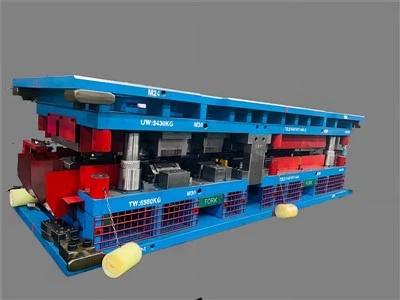
Hey there! As a supplier of Transfer Dies, I often get asked about what materials are used to make these essential tools. In this blog post, I'm gonna break down the different materials commonly used in Transfer Die manufacturing and explain why they're so important.
Tool Steels
Tool steels are the go - to materials for making Transfer Dies. They're known for their high hardness, wear resistance, and toughness, which are crucial properties for dies that have to withstand high pressures and repeated impacts during the stamping process.
One of the most popular tool steels for Transfer Dies is D2. D2 tool steel is a high - carbon, high - chromium cold - work tool steel. It has excellent wear resistance, which means the die can maintain its shape and precision over a long period of use. D2 also has good hardenability, so it can be heat - treated to achieve the desired hardness. This is important because a hard die surface can better resist the abrasion caused by the metal being stamped.
Another commonly used tool steel is A2. A2 is a medium - alloy air - hardening tool steel. It offers a good balance between hardness, toughness, and wear resistance. Compared to D2, A2 has better toughness, which makes it less likely to crack under high - stress conditions. This is particularly useful when the Transfer Die is used for complex stamping operations that involve bending and forming.
M2 is a high - speed tool steel that is sometimes used in Transfer Die manufacturing. M2 has extremely high hardness and wear resistance, especially at elevated temperatures. This makes it suitable for applications where the die is exposed to high - speed stamping or where the metal being stamped generates a lot of heat during the process.
Carbides
Carbides are another group of materials that are used in Transfer Dies, especially in applications where extreme wear resistance is required. Tungsten carbide is the most commonly used carbide in die making.
Tungsten carbide is made up of tungsten and carbon atoms bonded together in a very hard and dense structure. It has a much higher hardness than tool steels, which means it can resist wear and abrasion much better. Carbide inserts are often used in areas of the Transfer Die that are subject to the most wear, such as the cutting edges or the forming surfaces.
However, carbides are also more brittle than tool steels. This means they need to be carefully designed and supported within the die to prevent cracking. When using carbide inserts in a Transfer Die, the die design has to take into account the different thermal expansion rates of the carbide and the surrounding tool steel.
Other Materials
In addition to tool steels and carbides, there are other materials that play important roles in Transfer Die manufacturing.
Graphite is sometimes used as a lubricant in Transfer Dies. Graphite has a low coefficient of friction, which helps to reduce the wear between the die and the metal being stamped. It can also withstand high temperatures, making it suitable for use in high - speed stamping operations.
Copper alloys are used in some parts of the Transfer Die, such as the ejector pins or the cooling channels. Copper has good thermal conductivity, which allows it to transfer heat away from the die quickly. This helps to prevent the die from overheating and reduces the risk of thermal damage.
Plastic materials are also used in Transfer Dies, mainly for insulation and vibration damping. For example, some die components are coated with a layer of plastic to reduce noise and vibration during the stamping process.
Why Material Selection Matters
The choice of materials for a Transfer Die is not just about durability. It also affects the quality of the stamped parts, the efficiency of the stamping process, and the overall cost of production.
Using high - quality materials can result in better - quality stamped parts. A die made from a wear - resistant material will maintain its precision over a longer period, which means the stamped parts will have consistent dimensions and surface finishes.
The right materials can also improve the efficiency of the stamping process. For example, a die with good thermal conductivity can dissipate heat more quickly, which allows for higher - speed stamping without overheating the die.
Of course, material selection also has an impact on cost. High - performance materials like carbides are more expensive than tool steels. However, in the long run, using these materials can actually save money by reducing the frequency of die replacement and improving the productivity of the stamping process.
Progressive Metal Stamping and Transfer Dies
Transfer Dies are often used in Progressive Metal Stamping operations. Progressive Metal Stamping is a highly efficient manufacturing process where a strip of metal is fed through a series of stations in a die, with each station performing a different stamping operation.


In a Progressive Metal Stamping setup, the Transfer Die moves the metal strip from one station to the next in a precise and controlled manner. The materials used in the Transfer Die need to be able to handle the high - speed movement and the complex stamping operations involved in this process.
Sheet Metal Progressive Tool Design
The design of the Transfer Die is closely related to the Sheet Metal Progressive Tool Design. A well - designed Transfer Die takes into account the properties of the materials being used, as well as the specific requirements of the stamping operation.
For example, the design of the die has to ensure that the carbide inserts are properly supported and that the tool steel components have the right balance of hardness and toughness. The layout of the die also needs to be optimized to minimize the wear on the materials and to ensure smooth and efficient operation.
Progressive Die Manufacturing
The manufacturing process of a Transfer Die is an important part of Progressive Die Manufacturing. The materials are carefully selected and then machined, heat - treated, and assembled to create a high - quality die.
During the manufacturing process, strict quality control measures are in place to ensure that the die meets the required specifications. This includes checking the hardness, the dimensions, and the surface finish of the die components.
Conclusion
As a Transfer Die supplier, I know how important it is to choose the right materials for each application. Tool steels, carbides, and other materials all have their own unique properties and advantages, and the selection depends on factors such as the type of stamping operation, the metal being stamped, and the production volume.
If you're in the market for a Transfer Die, whether it's for Progressive Metal Stamping or other stamping applications, I'd love to have a chat with you. We can discuss your specific requirements and come up with the best material and design solutions for your project. Contact me to start the procurement negotiation, and let's work together to create the perfect Transfer Die for your needs.
References
- "Tool and Die Making Handbook"
- "Advanced Materials for Manufacturing"
- Industry publications on stamping and die making