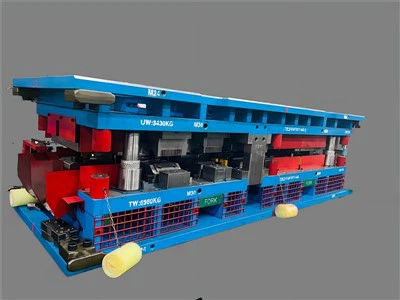
Hey there! As an automotive tooling supplier, I've been knee - deep in the world of automotive tooling for quite some time. 3D printing has been making waves in our industry, promising all sorts of amazing things. But let's be real – it's not all sunshine and rainbows. There are some limitations to 3D - printed automotive tooling that we need to talk about.
Material Limitations
First off, let's talk materials. In the automotive tooling game, we need tools that can withstand a lot of wear and tear. Traditional tooling materials like high - strength steels are known for their toughness, hardness, and ability to handle high - pressure operations.
3D printing materials, on the other hand, often fall short. Most 3D - printable polymers don't have the same level of strength and durability as metal. For example, when it comes to Sheet Metal Progressive Tool Design, the tools need to cut, bend, and form sheet metal repeatedly. A 3D - printed polymer tool might start to show signs of wear after just a few uses, which is a huge problem in a high - volume production environment.
Even when we look at 3D - printable metals, they still don't always match up to the properties of traditional forged or machined metals. The microstructure of 3D - printed metals can be different, with potential issues like porosity. This porosity can reduce the strength and fatigue resistance of the tool, making it more likely to fail under stress. For an Automotive Metal Stamping Die, which has to endure thousands of stamping cycles, these material limitations can be a deal - breaker.
Precision and Surface Finish
Precision is key in automotive tooling. Every part needs to be made to exact specifications, and the tools need to be just as precise. 3D printing technology has come a long way, but it still struggles to achieve the same level of precision as traditional machining methods.


In 3D printing, the layer - by - layer deposition process can lead to small variations in the final product. These variations might be negligible in some applications, but in automotive tooling, they can cause big problems. For example, in a Sheet Metal Progressive Tool, the clearances between different components need to be extremely precise. Even a tiny deviation can result in poor - quality parts or damage to the tool itself.
Surface finish is another area where 3D - printed tools often lag behind. Traditional machining methods can produce smooth, polished surfaces that are essential for proper tool function. 3D - printed surfaces, on the other hand, can be rough and have visible layer lines. This rough surface can cause issues like increased friction, which can lead to faster wear and tear on the tool and the parts it's working on.
Production Speed and Volume
When it comes to mass - producing automotive tools, 3D printing is just not as fast as traditional manufacturing methods. Traditional machining processes, like milling and turning, can produce parts at a much higher rate. In a high - volume production environment, time is money, and waiting for a 3D printer to finish a single tool can be a major bottleneck.
3D printing is an additive process, which means it builds the tool layer by layer. This takes time, especially for larger and more complex tools. In contrast, traditional manufacturing can often produce multiple tools simultaneously or complete a tool in a fraction of the time. For an automotive tooling supplier like me, this production speed limitation can make it difficult to meet the demands of our customers in a timely manner.
Cost
Cost is always a factor in any business decision, and 3D - printed automotive tooling is no exception. While 3D printing has the potential to reduce costs in some areas, like eliminating the need for expensive tooling set - ups, it also comes with its own set of costs.
The equipment for 3D printing can be quite expensive, especially for high - quality printers that can work with metal materials. The cost of the printing materials is also a consideration. 3D - printable polymers and metals can be more expensive than traditional materials, especially when you factor in the waste generated during the printing process.
In addition, post - processing is often required for 3D - printed tools. This can include things like removing support structures, sanding, and heat - treating. These post - processing steps add to the overall cost and time of producing the tool. For a large - scale automotive tooling project, these costs can quickly add up and make 3D - printed tools less cost - effective compared to traditional tooling.
Design Complexity and Integration
3D printing is often touted for its ability to create complex geometries that would be difficult or impossible with traditional manufacturing. However, in automotive tooling, this can also be a double - edged sword.
While it's true that 3D printing can produce intricate designs, integrating these complex tools into existing manufacturing systems can be a challenge. Automotive production lines are often highly optimized, and introducing a new 3D - printed tool might require significant re - engineering of the production process. This can be time - consuming and costly.
Also, just because a tool can be designed with complex geometries doesn't mean it's always the best design for the job. In some cases, a simpler, more traditional design might be more reliable and easier to maintain. Designers need to carefully consider whether the added complexity of a 3D - printed design is really worth it in terms of performance and cost.
Regulatory and Quality Assurance
The automotive industry is highly regulated, and tooling needs to meet strict quality and safety standards. 3D - printed automotive tooling is a relatively new technology, and there are still some uncertainties when it comes to regulatory compliance.
Traditional tooling manufacturing processes have well - established quality control procedures. Inspecting and certifying a 3D - printed tool can be more challenging. The unique properties of 3D - printed materials and the layer - by - layer manufacturing process require new inspection methods and standards. This can make it difficult for automotive tooling suppliers to ensure that their 3D - printed tools meet all the necessary regulatory requirements.
Conclusion
So, as you can see, while 3D printing has a lot of potential in the automotive tooling industry, it also has some significant limitations. These limitations in materials, precision, production speed, cost, design integration, and regulatory compliance mean that 3D - printed automotive tooling is not yet a one - size - fits - all solution.
But that doesn't mean we should write it off completely. 3D printing can still be a valuable tool in certain situations, like for prototyping or producing low - volume, highly customized tools. As the technology continues to evolve, we can expect some of these limitations to be addressed.
If you're in the market for automotive tooling, whether it's Sheet Metal Progressive Tool Design, Automotive Metal Stamping Die, or Sheet Metal Progressive Tool, I'd love to have a chat with you. We can discuss your specific needs and figure out the best solution for your project. Don't hesitate to reach out, and let's see how we can work together to meet your automotive tooling requirements.
References
- Smith, J. (2022). "Advances and Challenges in 3D - Printed Manufacturing for Automotive Applications." Journal of Automotive Engineering.
- Johnson, A. (2021). "Material Properties of 3D - Printed Metals for Tooling." International Journal of Manufacturing Technology.
- Brown, C. (2020). "Cost - Benefit Analysis of 3D - Printed Automotive Tooling." Automotive Industry Review.