Hey there! As a supplier in the high-speed stamping industry, I often get asked one question: What is the minimum feature size achievable in high-speed stamping? Well, let's dive right into it.
First off, high-speed stamping is an awesome process. It's used to make a whole bunch of parts really quickly. You know, things like electronic components, automotive parts, and even some stuff for furniture. And when we talk about feature size, we're referring to the smallest details or dimensions we can create on a stamped part.
Now, the minimum feature size in high-speed stamping isn't set in stone. It depends on a bunch of factors. One of the biggest ones is the material we're stamping. Different metals have different properties. For example, soft metals like aluminum are generally easier to stamp than harder ones like stainless steel. With aluminum, we can usually achieve smaller feature sizes because it's more malleable. The grain structure of the metal also plays a role. A fine-grained metal might allow for more precise stamping compared to a coarse-grained one.
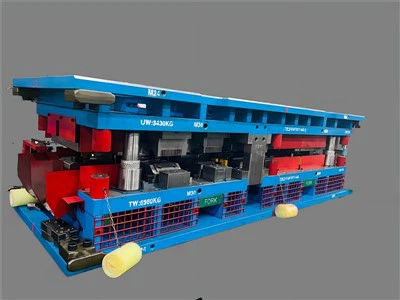
Another crucial factor is the stamping equipment. High-quality presses with advanced control systems can offer better precision. The speed of the press matters too. If the press is running too fast, it might cause issues like burrs or deformation, which can limit the minimum feature size. On the other hand, a well-tuned press can maintain accuracy even at high speeds. The die used in the stamping process is also key. A High Precision Stamping Die is designed to create detailed and accurate features. The quality of the die's machining, the materials used to make it, and how well it's maintained all impact the achievable feature size.
The design of the part itself is also a major consideration. Complex shapes with tight corners or thin walls can be more challenging to stamp. For instance, if a part has a very thin wall section, there's a risk of it breaking or deforming during the stamping process. So, the minimum feature size in these cases might be larger compared to a simpler design.
In general, with today's technology, we can achieve feature sizes as small as a few tenths of a millimeter in high-speed stamping. However, this is under ideal conditions. For example, if we're stamping a simple shape out of a soft metal using a top-of-the-line press and a high-precision die, we might be able to get down to around 0.1 - 0.2 mm. But if we're dealing with a more complex part or a harder metal, the minimum feature size could be closer to 0.5 - 1 mm.
Let's take a look at some real-world applications. In the electronics industry, where miniaturization is a big deal, high-speed stamping is used to create tiny components. These components often require very small feature sizes to fit into the compact devices. For example, the connectors in a smartphone need to have precise dimensions to ensure proper electrical contact. Here, the ability to achieve small feature sizes is crucial.
In the automotive industry, high-speed stamping is used to make various parts like brackets and clips. While the feature sizes might not be as small as in electronics, they still need to be accurate. A bracket that's stamped with the wrong dimensions could lead to fitting issues in the vehicle assembly.
When it comes to furniture hardware, high-speed stamping also plays a significant role. Furniture Hardware Stamping Die are used to create parts like hinges, handles, and decorative elements. These parts often need to have a certain level of detail and precision. The minimum feature size here can vary depending on the design and the type of furniture. For example, a high-end, designer piece of furniture might require more intricate and smaller features compared to a standard, mass-produced item.
Now, if you're in the market for high-speed stamping services, you need to consider a few things. First, make sure the supplier has experience in working with the type of material and part design you need. Ask about their equipment and die-making capabilities. A good supplier should be able to provide samples or case studies to show their track record in achieving small feature sizes.
We at our company have been in the high-speed stamping business for a long time. We've invested in top-notch equipment and have a team of experts who are constantly working on improving our processes. We understand the challenges of achieving small feature sizes and have developed techniques to overcome them. Whether you need a simple part with a small detail or a complex component with multiple features, we're confident we can meet your requirements.
If you're interested in Metal Stamping Tool And Die for your high-speed stamping needs, we can also help with that. We offer a range of high-quality dies that are designed to create accurate and detailed parts. Our dies are made from the best materials and are precision-machined to ensure long-lasting performance.


So, if you're looking for a reliable high-speed stamping supplier, don't hesitate to reach out. We're here to discuss your project, answer your questions, and provide you with a quote. Whether you're in the electronics, automotive, furniture, or any other industry, we have the expertise and capabilities to help you achieve the minimum feature sizes you need for your parts.
References:
- "Metal Stamping Handbook" - A comprehensive guide on the principles and practices of metal stamping.
- Industry research reports on high-speed stamping technology and its advancements.