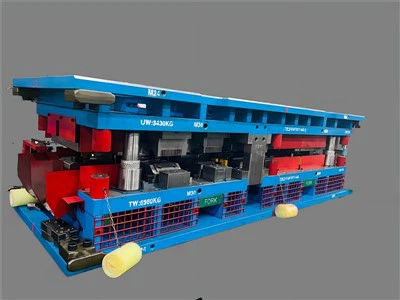
Hey there! As a stamping die supplier, I've seen firsthand how the speed of stamping dies can have a major impact on product quality. In this blog, I'm gonna break down what's going on and share some insights that I hope will be useful for you.
Let's start with the basics. Stamping dies are used to shape and cut metal sheets into various parts. The speed at which these dies operate is a crucial factor that can affect the end - product in several ways.


Surface Finish
One of the most noticeable impacts of stamping die speed on product quality is the surface finish. When the die operates at a very high speed, there's a greater chance of generating heat. This heat can cause the metal to deform in an uneven way, leading to a rough or pitted surface finish. For example, if you're stamping out small decorative metal parts, a poor surface finish can make them look unprofessional and reduce their market value.
On the other hand, if the speed is too slow, it might lead to inconsistent material flow. The metal might not be formed smoothly, leaving behind marks or ridges on the surface. So, finding that sweet spot in die speed is essential for getting a smooth and uniform surface finish.
Dimensional Accuracy
Dimensional accuracy is another key aspect of product quality. High - speed stamping can sometimes result in the part not being formed exactly to the desired dimensions. The rapid movement can cause the metal to spring back more than expected after being stamped. This spring - back effect can lead to parts that are either slightly larger or smaller than the required size. For instance, in the automotive industry, where parts need to fit together precisely, even a tiny deviation in dimensions can cause major problems during assembly.
Conversely, when the die speed is too low, the metal may cool too slowly. This can lead to additional shrinkage as it cools, again affecting the final dimensions of the part. It's like trying to bake a cake: if you cook it too fast, it might burn on the outside and be raw inside; if you cook it too slow, it might not rise properly.
Material Integrity
The integrity of the material being stamped is also influenced by die speed. At high speeds, the metal is subjected to rapid and intense forces. This can cause micro - cracks to form on the surface or even inside the material. These micro - cracks may not be visible to the naked eye, but they can significantly weaken the part over time. For example, in aircraft components, even a small crack can be a safety hazard.
When the speed is too low, the material may not be formed efficiently, leading to areas of uneven stress distribution. This can also compromise the long - term integrity of the part.
Burr Formation
Burrs are small, unwanted pieces of metal that are left on the edges of a stamped part. Die speed plays a big role in burr formation. High - speed stamping can sometimes cause the metal to shear unevenly, resulting in large and jagged burrs. These burrs not only make the part look unappealing but can also pose a safety risk, especially if the part is handled by workers.
If the speed is too slow, the metal may not be cut cleanly, and small burrs can still form. Removing burrs is an additional step in the manufacturing process that adds time and cost. So, by optimizing the die speed, you can minimize burr formation and save on post - processing expenses.
Transfer Die Stamping
Now, let's talk about transfer die stamping. Transfer die stamping is a process where the workpiece is transferred from one station to another in a progressive die setup. The speed of transfer die stamping can have a unique impact on product quality.
In transfer die stamping, a high - speed operation can improve productivity. But if the transfer speed is not synchronized properly with the stamping speed, it can lead to misaligned parts. This misalignment can cause defects such as bent or distorted parts. On the other hand, a slow transfer speed can reduce the overall efficiency of the process and may also lead to inconsistent part quality due to longer exposure to environmental factors like temperature changes.
Finding the Optimal Speed
So, how do you find the optimal stamping die speed? Well, it's not a one - size - fits - all answer. It depends on several factors, including the type of metal being stamped, the complexity of the part, and the design of the die itself.
For softer metals like aluminum, you can generally operate the die at a higher speed compared to harder metals like stainless steel. The complexity of the part also matters. A simple, flat part can often be stamped at a faster speed than a part with intricate curves and details.
You can also use advanced technologies like sensors and monitoring systems to measure the performance of the die during operation. These systems can provide real - time data on factors like temperature, pressure, and speed, allowing you to make adjustments on the fly.
Impact on Production Costs
The relationship between die speed and product quality also has a direct impact on production costs. If the die speed is not optimized, you may end up with a higher rate of defective parts. These defective parts need to be either reworked or scrapped, which adds to the cost of production.
On the other hand, by finding the right speed, you can increase the overall efficiency of the stamping process. You'll have fewer rejects, less post - processing work, and a higher throughput. This means that you can produce more high - quality parts in less time, ultimately reducing the cost per part.
Our Role as a Stamping Die Supplier
As a stamping die supplier, we understand the importance of getting the die speed right. We work closely with our customers to design and manufacture dies that are tailored to their specific needs. We take into account the type of material, the part design, and the desired production volume to recommend the optimal die speed.
We also provide ongoing support to our customers. If they encounter any issues with product quality related to die speed, we're there to help them troubleshoot and make the necessary adjustments. Our goal is to ensure that our customers can produce high - quality parts consistently and cost - effectively.
Contact Us for a Better Solution
If you're in the market for stamping dies or if you're facing challenges with your current stamping process, we'd love to hear from you. Whether it's about optimizing die speed or improving overall product quality, our team of experts is ready to assist you. Reach out to us, and let's start a conversation about how we can help you take your stamping operations to the next level.
References
- "Metal Forming Handbook" by L. Lange
- "Stamping Die Design and Manufacturing" by S. Kalpakjian and S. Schmid
- Industry research reports on stamping die technology and product quality