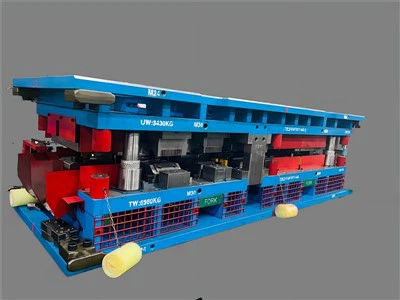
Washer stamping dies play a crucial role in the manufacturing of washers, which are essential components in various industries, including automotive, aerospace, and home appliances. As a leading washer stamping die supplier, I have extensive experience in designing and producing different types of dies to meet the diverse needs of our customers. In this blog post, I will introduce the different types of washer stamping dies and their applications.
Simple Dies
Simple dies, also known as single-operation dies, are the most basic type of stamping dies. They are designed to perform a single stamping operation, such as blanking, piercing, or bending, in one stroke of the press. Simple dies are relatively inexpensive to manufacture and are suitable for low-volume production or prototyping.
The design of a simple die is straightforward. It consists of a punch and a die block, which are mounted on the press. The punch is the male part of the die, and it is used to apply force to the workpiece. The die block is the female part of the die, and it contains the cavity or opening that determines the shape of the stamped part.
For example, a simple blanking die is used to cut a flat piece of material into a specific shape. The punch is shaped like the desired part, and when it is forced into the die block, it shears the material along the perimeter of the punch, creating a blank. Simple piercing dies, on the other hand, are used to create holes in a workpiece. The punch is a cylindrical shape, and when it is forced through the material, it creates a hole.
Compound Dies
Compound dies are more complex than simple dies and are capable of performing multiple stamping operations in a single stroke of the press. They are designed to produce parts with a high degree of accuracy and precision. Compound dies are commonly used in high-volume production applications where efficiency and quality are critical.
A compound die typically consists of a punch and a die block, similar to a simple die. However, the punch and die block are designed to perform multiple operations simultaneously. For example, a compound die can be used to perform blanking and piercing operations in one stroke. The punch is designed with a cutting edge for blanking and a smaller punch for piercing. When the press is activated, the punch descends into the die block, and the blanking and piercing operations are performed simultaneously.
The advantage of using a compound die is that it reduces the number of operations required to produce a part, which increases production efficiency and reduces costs. Additionally, compound dies can produce parts with a high degree of accuracy and repeatability, which is essential for applications where tight tolerances are required.
Progressive Dies
Progressive dies are the most advanced type of stamping dies and are used for high-volume production of complex parts. They are designed to perform multiple stamping operations in a sequential manner as the workpiece moves through the die. Progressive dies are commonly used in the automotive, electronics, and home appliance industries.
A progressive die consists of a series of stations, each of which performs a specific stamping operation. The workpiece is fed through the die on a strip of material, and as it moves from one station to the next, it undergoes a series of operations, such as blanking, piercing, bending, and forming. The final part is then separated from the strip at the end of the die.
One of the key advantages of using a progressive die is its high production efficiency. Since multiple operations are performed in a single pass through the die, the production rate can be significantly increased compared to using simple or compound dies. Additionally, progressive dies can produce parts with a high degree of accuracy and consistency, which is essential for mass production.
If you are interested in learning more about progressive die metal stamping, you can visit our website Progressive Die Metal Stamping.
Transfer Dies
Transfer dies are similar to progressive dies in that they are used for high-volume production of complex parts. However, instead of the workpiece moving through the die on a strip of material, transfer dies use a transfer system to move the workpiece from one station to the next. Transfer dies are commonly used in the automotive industry for the production of large, complex parts, such as engine blocks and body panels.
A transfer die consists of a series of stations, each of which performs a specific stamping operation. The workpiece is loaded onto a transfer system, which moves it from one station to the next. At each station, the appropriate stamping operation is performed, and the workpiece is then transferred to the next station. The final part is then removed from the die at the end of the process.
The advantage of using a transfer die is that it can handle larger and more complex parts than progressive dies. Additionally, transfer dies can be more flexible in terms of the types of operations that can be performed, as the workpiece can be rotated or repositioned between stations.
Combination Dies
Combination dies are a type of die that combines the features of two or more different types of dies. For example, a combination die can be a combination of a simple die and a compound die, or a progressive die and a transfer die. Combination dies are designed to meet the specific needs of a particular application and can offer the advantages of multiple die types.
The design of a combination die depends on the specific requirements of the application. For example, a combination die for producing a complex part may include a progressive die section for performing multiple stamping operations in a sequential manner and a transfer die section for handling the larger and more complex parts.
Applications of Washer Stamping Dies
Washer stamping dies are used in a wide range of applications, including:
- Automotive Industry: Washers are used in various automotive components, such as engines, transmissions, and brakes. Washer stamping dies are used to produce high-quality washers with precise dimensions and tolerances.
- Aerospace Industry: In the aerospace industry, washers are used in critical components where reliability and performance are essential. Washer stamping dies are used to produce washers that meet the strict quality and safety standards of the aerospace industry.
- Home Appliance Industry: Washers are used in many home appliances, such as washing machines, dryers, and microwave ovens. Washer stamping dies are used to produce washers that are durable and reliable. If you are interested in microwave oven dies, you can visit our website Microwave Oven Die.
- Electronics Industry: Washers are used in electronic devices to provide insulation, support, and protection. Washer stamping dies are used to produce small, precise washers that are suitable for use in electronic applications.
Conclusion
As a washer stamping die supplier, we understand the importance of providing high-quality dies that meet the specific needs of our customers. We offer a wide range of washer stamping dies, including simple dies, compound dies, progressive dies, transfer dies, and combination dies. Our dies are designed and manufactured using the latest technology and materials to ensure high performance, accuracy, and durability.
If you are in the market for washer stamping dies, we encourage you to contact us to discuss your requirements. Our team of experts will work with you to understand your needs and provide you with the best solution for your application. Whether you need a simple die for low-volume production or a complex progressive die for high-volume production, we have the expertise and experience to meet your needs.


We also offer Progressive Die Tooling services to help you optimize your stamping process and improve your productivity. Our progressive die tooling solutions are designed to reduce costs, increase efficiency, and improve the quality of your stamped parts.
Don't hesitate to reach out to us for more information or to start a procurement discussion. We look forward to working with you to meet your washer stamping die needs.
References
- Tool and Manufacturing Engineers Handbook, Volume 4: Stamping
- Metal Stamping Handbook, by Peter Ulintz
- Die Design Handbook, by William H. Dieter